


Monet's Japanese Bridge
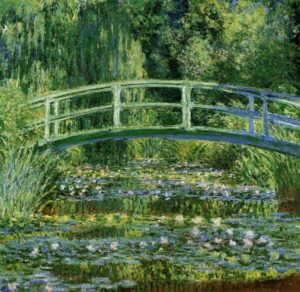
Monet built a wooden footbridge over the lily pond in his garden at Giverny, then painted it many times.
Looking for a painting that is not on this page? Search it by title. If it’s public domain, we paint it.
About the series
After buying land beside his house at Giverny in 1893, Claude Monet dug a pond, planted water lilies and built an arched wooden footbridge in the Japanese style. He was a keen collector of Japanese prints, and the bridge echoes the ones he knew from them.
In 1899 and 1900 he painted a group of views of the bridge from the same spot, with the green arch crossing the canvas above the lilies and willow leaves hanging around it. Examples hang in the National Gallery in London, the Metropolitan Museum of Art in New York and the Musée d'Orsay in Paris. Late in life, when cataracts affected his sight, Monet returned to the bridge in a series of loosely painted canvases in strong reds, yellows and greens, painted around 1918 to 1924.
The 1899 views are close to square and fit most rooms. A bridge painting pairs naturally with one of Monet's Water Lilies from the same pond.